Thursday, January 27, 2011

Some Basic Tips for Analyzing Poetry

Most students are far more comfortable reading and discussing prose than poetry, though that's usually a product of their lack of familiarity with the latter. We'll be dealing exclusively with poetry for the next three weeks (between Mexico City Blues and the work of Allen Ginsberg), then return to it in the second-to-last week when we work with Gregory Corso, and this work can be challenging at times, so it's best to start developing your analytic abilities now.  Below, you'll find two different strategies for working your way through a poem, which should be particularly useful now, when your instincts and comfort level aren't fully established. 


This is a quick and simple five-step plan that should be fairly helpful as you work your way through the readings. Though it's better suited to more traditional poetry, it will still offer some useful questions to ask when reading through a poem:

1. What is happening in the poem?
  • Literally: What is the poem’s action?
  • Figuratively: What metaphors drive the poem’s message?

2. Comment on the poem’s music: What do you hear in this poem?
  • the poet’s voice, the language used
  • use of rhyme and near rhyme
  • the poem’s rhythms, its cadence, its momentum
  • use of alliteration and assonance
  • performative enjambments (line breaks)
(All of these elements add emphasis to certain words, images and ideas. Why?)


3. Are there any memorable images? What do you see in this poem?


4. What general themes does the poet touch upon?


5. Ultimately, what is the poet/poem trying to say?


Another method of working your way through a poem comes from an interview with Ann Lauterbach in Daniel Kane's What is Poetry: Conversations with the American Avant-Garde:

DK: Is there a method or series of steps that you might recommend teachers to take in presenting "On (Open)" [a poem of Lauterbach's they'd been discussing] to high school students not so familiar with poetry?

AL: A poem is not a puzzle to be solved. A poem is an experience, an event, in and of language. It should be approached as such:
  • What kind of event happened to you when you read this poem?
  • Did you get a feeling?
  • Did you have an idea?
  • Did you get reminded of something?
  • Did you go elsewhere, away from the familiar world into another, stranger, one?
  • Did you look up words and find out new meanings, as you would ask directions in a strange city?
  • Why do you think the poet made this word choice, and not another?
  • Why do you think the line is broken here, at this word, and not at another?
  • How is a line break in a poem different from a comma or a period in a prose sentence?

If you're interested in a far more comprehensive introduction to poetry, definitely check out Edward Hirsch's multi-part essay "How to Read a Poem (and Fall in Love with Poetry)," available through the Poetry Foundation website.

Also, here's a link to a poetics glossary to help you sort out any unfamiliar terms you might come across (including, perhaps, some used above), and a primer on poetic forms and techniques.

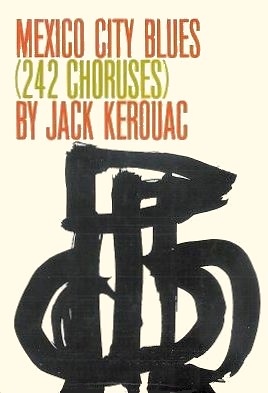
Jack Kerouac, "Mexico City Blues (242 Choruses)"

Our final reading from Jack Kerouac will continue on themes and locations present in On the Road and The Subterraneans, and also serve as a transition from prose (albeit highly poetic prose) to poetry, setting us up nicely for two weeks exploring the work of Allen Ginsberg.

While Kerouac's long prose excursions were largely the products of time spent in recollection at the end of his journeys (after all, a typewriter and long rolls of teletype paper aren't that easy to drag along the road), his poetry was rooted in a spontaneous, portable materiality, crafted in the moment of inspiration, out in the world.  He explains his poetics thusly:

In my system, the form of blues choruses is limited by the small page of the breastpocket notebook in which they are written, like the form of a set number of bars in a jazz blues chorus, and so sometimes the word-meaning can carry harmonically from one chorus into another, or not, just like the phrase-meaning can carry harmonically from one chorus to the other, or not, in jazz, the form is determined by time, and by the musicians' spontaneous phrasing & harmonizing with the beat of the time as it waves & waves on by in measured choruses.

It's all gotta be non stop ad libbing within each chorus, or the gig is shot.

Though divided into 242 choruses, Mexico City Blues is, Kerouac tells us, essentially one long interrupted poem, and we'll keep that in mind as we work through it.  Also, as Kerouac notes above, while many of the poems can stand alone, there are many instances where several run together to form a longer train of thought.  One example is Choruses 239-241, which Kerouac performed under the title "Charlie Parker" on his 1959 album (with Steve Allen on piano), Poetry for the Beat Generation:


Here are a few other settings of Mexico City Blues poems from that album:


221st Chorus, "Deadbelly"


149th Chorus, "One Mother"


Choruses 80-83, "Goofing at the Table"


211th Chorus, "The Wheel of the Quivering Meat Conception"


104th Chorus, "I'd Rather Be Thin Than Famous"


One person on whom Kerouac's work, and Mexico City Blues in particular, made a great impression (along with the work of Ginsberg and Burroughs) is Bob Dylan, as evidenced by this passage from Sean Wilentz's Bob Dylan in America, published in The New Yorker:
Dylan knew the poems, Ginsberg later claimed. “Someone handed me Mexico City Blues in St. Paul in 1959,” Dylan told him. “It blew my mind.” It was the first poetry he’d read that spoke his own American language, Dylan said — or so Ginsberg said he said. Maybe, maybe not. Without question, though, Dylan read Mexico City Blues and was deeply interested in Beat writing before he left Minneapolis for New York. (Like other Beats and hipsters, his friend Tony Glover ordered a paperback copy of William Burroughs’s Naked Lunch from France, where it had been published by Olympia Press in Paris in 1959 as The Naked Lunch — uncertain whether the book, deemed obscene by American authorities, would clear customs. The book indeed arrived, and Glover lent it to Dylan, who returned it after a couple of weeks.) And Dylan’s involvement with the writings of Kerouac, Ginsberg, Burroughs, and the rest of the Beat generation is nearly as essential to Dylan’s biography as his immersion in rock and roll, rhythm and blues, and then Woody Guthrie. “I came out of the wilderness and just naturally fell in with the Beat scene, the bohemian, Be Bop crowd, it was all pretty much connected,” Dylan said in 1985. “It was Jack Kerouac, Ginsberg, Corso, Ferlinghetti … I got in at the tail end of that and it was magic … it had just as big an impact on me as Elvis Presley.”
[note: the entire piece merits reading]

We'll be covering Mexico City Blues in two classes, with several student presentations, each covering one chorus or group of choruses.  Put on some jazz, indulge in the intoxicant of your choice (nicotine, caffeine, etc.) and enjoy the unbridled flow of language.  Better yet, read them out loud and freak out your roommates — these are made to be heard, not just read!

Here's the breakdown:
  • Tuesday, Feb. 1st: Choruses 1-148 // presentations by Taylor Panning & Sarah Gullion
  • Thursday, Feb. 3rd: Choruses 149-242 [no presentations, but if someone who hasn't signed up for a presentation wants to present, that's great — e-mail me]

Here are a few additional links and videos for your perusal:


Ginsberg and Dylan read from Mexico City Blues at Kerouac's grave (as mentioned in the Wilentz essay)


Johnny Depp performs the 113th Chorus (in a delightfully dated video)


Tuesday, January 25, 2011

Screenings Confirmed / Room Changed

I've just received confirmation that we're all set for this evening's screening of  Chuck Workman's The Source (1999).  While the room has changed (to 046 McMicken), the time is the same, and we'll discuss in class whether folks would prefer to start right at 5:00 or a little later so you'll have a chance to grab a bite to eat first.

We also have the same classroom booked for next Tuesday evening (2/1), when I'll be showing Richard Lerner & Lewis MacAdams' 1986 documentary, What Happened to Kerouac?  I hope to see many of you at both!

Thursday, January 20, 2011

Jack Kerouac, "The Subterraneans"

Once I was young and had so much more orientation and could talk with nervous intelligence about everything and with clarity and without as much literary preambling as this; in other words this is the story of an unself-confident man, at the same time of an egomaniac, naturally, facetious won't do—just to start at the beginning and let the truth seep out, that's what I'll do—.  It began on a warm summernight—ah, she was sitting on the fender with Julien Alexander who is . . . let me begin with a history of the subterraneans of San Francisco . . .

Thus begins Jack Kerouac's The Subterraneans, the next book we'll be reading this term.

After the sudden success of On the Road  Kerouac's publishers wanted to move quickly to capitalize on his notoriety, and The Subterraneans was the first of two books released in 1958 (the other being the classic The Dharma Bums), within one year of On The Road.   The Subterraneans was not only speedily published, but also speedily written — while On the Road's first draft came together in three weeks, Kerouac wrote this book during a three day binge of caffeine and benzadrine (a popular stimulant of the era). Not surprisingly, the novella is a fine example of the author's spontaneous prose style, riddled with long, poetically recursive run-on passages.

We had a few fruitful class discussions of the complicated nature of Kerouac's relation to other races and cultures, and once again, it's at the heart of this book, which focuses on a brief love affair Kerouac (here called Leo Percepied) had with an African-American woman, Alene Lee (called Mardou Fox in the book) in 1953.  Here's a photo by Allen Ginsberg of Lee (with William S. Burroughs) around the time of the books events:


The Subterraneans' depiction of an interracial love affair was so controversial by late-1950s standards that when a (quite awful) film adaptation of the novel was made in 1960, the female love interest was changed to a young French woman.

As in On The Road, many of Kerouac's friends and fellow Beat Generation writers appear under pseudonyms within the narrative.  Burroughs appears as Frank Carmody, while Ginsberg is Adam Moorad; Cassady is mentioned in passing as Leroy, and Gregory Corso (our last Beat author of the term) plays a major role in the novel under the name Yuri Gligoric.  Though the real-life  events took place in New York City, Kerouac chose to switch the location to San Francisco (a city he was well-acquainted with at this time).

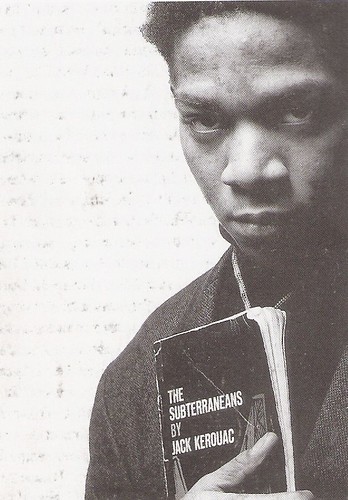
Kerouac spent quite a bit of time and effort defending the ethos of the Beats once they came under the scrutiny of the general public, and I'm providing a PDF file of a few brief essays on this topic ("About the Beat Generation" [1957], "Lamb, No Lion" [1958] and "Beatific: The Origins of The Beat Generation" [1959]) here: [link].  This novel's title, however, says quite a bit about his intentions (or wishes) for the shared philosophies of the Beats — namely that it remain hidden underground, a secret underworld paradise — and if the name reminds you of Bob Dylan's "Subterranean Homesick Blues," you're on the mark:  Dylan's just one of many artists, writers and musicians who were inspired by Kerouac's prose and this book in particular.  Painter Jean-Michel Basquiat, for example, is shown at right photographed with his well-thumbed copy of the book (one of his favorites), and David Bowie used the title for one of the instrumental pieces on his 1977 album, Low, which serves as the soundtrack for the very strange YouTube video below (a mix of Bowie's music, Kerouac reading a passage from the novel and footage of artist Jackson Pollock):


Originally, we'd planned to discuss the book over two days, however due to our snow day, we'll try to restrict most of our discussion to next Thursday's class.  Since our reading was going to be split into two presentations over two days, Tuesday's presenter, Hannah Moore will talk about part 1 of the book, while Hannah Henschel (Thursday's presenter) will talk about part 2.

Snow Day / Schedule Shift

Well, it looks as if UC's administration came to its senses in regards to the weather, and though it's a hassle to have to shift our schedule a bit, it's likely for the best — no one needs to get hurt for the sake of a class!

So here's how we'll proceed: in terms of readings, we'll bump Neal Cassady's The First Third forward one class to Tuesday, then aim to cover most of Jack Kerouac's novella, The Subterraneans, next Thursday (you should read the entire book for Thursday, and we'll have both of our presentations on the same day).  We'll carry over that conversation into the start of the following week's first class on Kerouac's Mexico City Blues, along with two student presentations on poems from the latter, and we'll wrap Kerouac up at the end of the week.

In terms of the film screenings, I haven't received definitive word from the English Dept. yet, but I've tentatively scheduled The Source (the film the pedagogical/weather gods don't want you to see) for next Tuesday from 5-7 PM, and we'll aim to watch What Happened to Kerouac? the following Tuesday at the same time.  Looking ahead, we can watch The Life and Times of Allen Ginsberg during our two weeks on the poet, and Howard Brookner's Burroughs the Movie during Week 8.  It's a longshot, but I might also try getting in touch with Gustave Reininger, director and producer of Corso: the Last Beat — a documentary that's shown at a few festivals and special events (including a Corso exhibition here at UC two years ago) that's yet to find a distributor — to see if he'd lend us a copy to view.

Here's the revamped schedule once more:
Week 4
  • Tuesday, Jan.  25: Neal Cassady, The First Third // presentation by Jenna Chiavacci 
  • Thursday, Jan. 27: Jack Kerouac, The Subterraneans // presentations by Hannah Moore & Hannah Henschel

Week 5
  • Tuesday, Feb. 1: Jack Kerouac, The Subterraneans (carry over) / Mexico City Blues, day 1 // presentations by Taylor Panning & Sarah Gullion
  • Thursday, Feb. 3: Mexico City Blues, day 2 // (no one signed up to present)

Kerouac on Steve Allen

Here's the video clip we ended our last class with — Jack Kerouac's appearance on The Steve Allen Show in 1959.  I misspoke, by the way, when I said that this was the historic precursor of what's now known as The Tonight Show.  Allen hosted Tonight Starring Steve Allen from 1954-1957, leaving late night to move to prime time for The Steve Allen Show.  He was replaced by Jack Paar, who left for primetime himself in 1962, opening the door for a little known comedian named Johnny Carson (and the rest, as they say, is history):

Screening Postponed, Class Still On

I hope your snowy morning is off to a good start, and I have to admit that I'm quite surprised that UC hasn't called a snow day yet, which means that we'll still meet for class as scheduled.  

For safety's sake, however, I think it's a good idea to postpone our screening of The Source for the time being, as the early evening hours are supposed to be the worst of the storm, and I don't want to keep anyone away from home unnecessarily.  I'm trying to rebook a room and will let you know the details when I get them, but I'm thinking we'll watch The Source next Tuesday and What Happened to Kerouac? the following Tuesday.  Keep an eye on the news (perhaps class will be canceled after all) and be safe getting to and from campus today!